
Fire Alarm Testing Notice Hotel Staff and Guests Will Understand
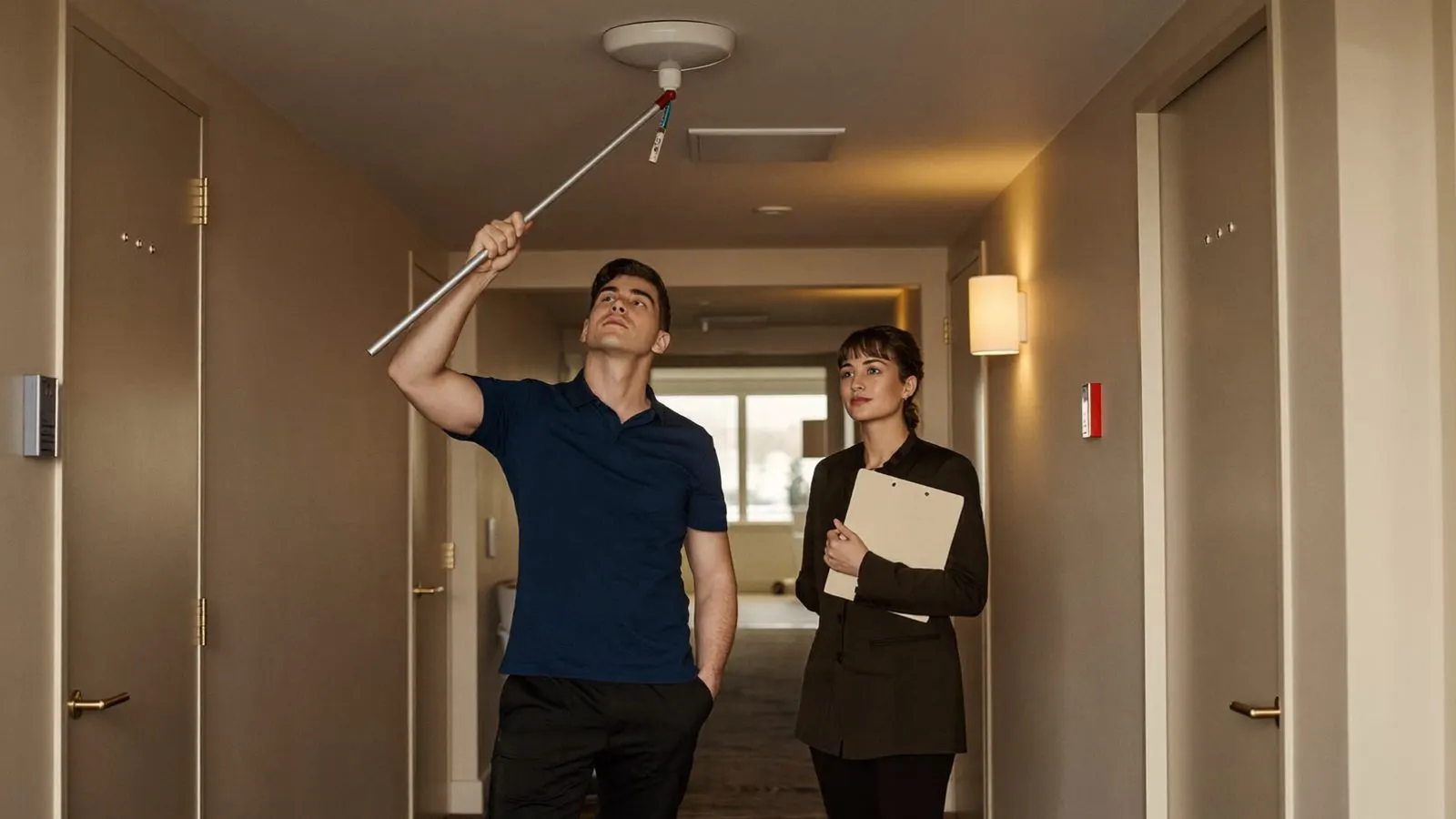
A fire alarm testing notice hotel guests and staff actually read is the difference between a quiet test and a lobby full of people heading for the exits. The contractor does the testing. The timing, the notice and the log are yours to run, and they decide whether the test costs you a complaint or a false dispatch.
Most problems on test day come from one person who did not know. That could be a night auditor who sees the alarm board light up, a room attendant who hears a horn in a stairwell, or a guest who read nothing. Put the sequence below on paper once and reuse it every time.
Schedule the test around occupancy
Your fire alarm contractor, not your team, performs the test. Under NFPA 72, inspection and testing must be done by qualified personnel, and your fire protection contractor and local fire marshal decide the intervals and scope that apply to your building. Confirm those with them. For how this fits into your wider calendar, see the contractor-test section of the hotel safety checklist.
What you control is the day and the hour. Work from your forecast:
- Pick the lowest-occupancy day you can get. Midweek in a leisure market and Sunday in a business hotel are common choices. Check group blocks, weddings and conferences before you agree to a date.
- Avoid the pinch points. That means the check-in rush, the check-out rush, breakfast service, and the hours when night-shift staff or guests with early flights are asleep.
- Ask how the contractor will run it. A full-building test with every horn sounding is very different from a floor-by-floor sequence. Ask for the order of floors and the expected hours so you can tell guests a real window.
- Plan around what the test trips. Elevator recall, smoke control, door release and similar emergency control functions need to be identified in advance and the trades coordinated, as NFPA 72 sets out. Elevators that park and doors that release affect deliveries, banquets and wheelchair users. Tell the people who run those areas.
- Hold back sensitive rooms. Flag any guest you know has a medical, sensory or childcare need, and anyone in a room that will be tested early. A phone call from the manager beats a letter slid under the door.
Who needs to be told, and when
The code is clear about the principle. NFPA 72 calls for everyone receiving alarm, supervisory or trouble signals, and the building occupants, to be notified before testing to prevent unnecessary response. Editions and local amendments differ, so confirm the current wording with your contractor. In a hotel, that translates to a notice list with a lead time for each group.
The monitoring company and the fire department
Put the system on test with the supervising station before any signal goes out, and confirm it is restored at the end, as NFPA 72 requires. Skipping either step can cause a false dispatch or leave the building unprotected on paper. Usually your contractor makes this call. Ask for the name of the person at the monitoring company who put you on test, and the time. Some jurisdictions also want the fire department told, and under NFPA 72 notifying the fire department is required where the authority having jurisdiction says so. Ask your fire marshal's office or your contractor whether that applies to you.
Your own staff
Give staff the details early, then remind them on the day.
- A week ahead: department heads get the date, window, floors and who is on the test team. Housekeeping needs it to plan room assignments, and banquets and engineering need it to plan deliveries and work orders.
- The day before: the pre-shift meeting and the handover note both carry it. Night audit should read it out loud to the morning front desk.
- Front desk: needs a script, the contractor's mobile number, and a clear rule on what to say if a guest asks whether it is real. Include the first-floor and lobby windows, because that is where guests ask.
- Housekeeping: attendants inside rooms during the test need to know what they will hear and that they should keep working unless they hear an evacuation announcement or a radio call stating it is a real emergency. If they see smoke or fire themselves, they follow the response plan immediately and don't wait for an announcement. Tell them which floors are in the sequence and when.
- Engineering: assigns one person to the panel and one to the floors with the contractor. Everyone else should still be reachable.
- Security and the manager on duty: know the exact start and stop times so any real alarm in that window is treated as real. Decide in advance how a real alarm interrupts the test.
Guests
Reach them three times: at booking confirmation or pre-arrival if the date is fixed, at check-in with a short card and a verbal mention, and in the room with a notice at the door or on the desk the morning of the test. Add a note on digital signage and on the in-room TV if your property uses one. Do not rely on a single letter under the door. Guests who arrive that day are the ones who never see it.
What the notice should say so nobody mistakes a test for a real alarm
A test notice fails when it sounds like a warning or an apology. A short, plain notice works better. It should hold five things:
- The date and the window, with the hours in plain numbers.
- What they will hear and see: horns, strobes, spoken announcements, elevators parking.
- The word "test" and "scheduled" in the first line.
- What to do: nothing for the test itself.
- A line for the real thing: if you see smoke or fire, or hear an evacuation announcement, leave immediately and report it.
Sample guest wording:
Scheduled fire alarm test, Wednesday, 10:30 a.m. to 1:00 p.m. Our fire alarm contractor will test the building's alarm system. You may hear horns and an announcement, see flashing lights, and find elevators briefly unavailable. This is a scheduled test and no action is needed for it. If you see smoke or fire, or hear an announcement to evacuate, leave the building immediately and report it. Questions? Call the front desk at extension 0.
Sample staff wording for the pre-shift board and radio:
Alarm test today, 10:30 to 1:00, floors 6 down to 1, then the lobby and back of house. Monitoring is on test. Elevator recall will run. Treat any alarm outside the window, any radio call that says "real alarm," or any smoke or fire you find as real and follow the response plan immediately. Test team lead: [name], radio channel [number].
Two rules for staff announcements. Put "test" in the first two words of every radio call, and end the test with a clear "test complete, system restored" call. A radio that goes quiet without a close leaves half the building unsure.
Keep the test notice and the response plan separate. Do not tell staff to ignore horns. Tell them what is scheduled, and that any alarm outside the stated window or floors, or any sign of smoke or fire, gets the normal response in your fire alarm response walkthrough.
Run the test day
The leaving-it-to-chance parts are the ones that go wrong. Treat the morning like a short operation:
- Confirm the contractor's arrival and the order of floors before 9:00 a.m. or whenever your first window starts.
- Verify monitoring is on test. Write down the time and the person's name.
- Post the in-room notices and brief the front desk with the script.
- Have a runner with a radio at the front desk, not just a phone, so a real alarm can stop the test immediately.
- Stay out of the contractor's way. Electrical and panel work is licensed work. Your engineers watch and support, they do not reset or bypass anything unless the contractor directs it and your policy allows it.
- Close the loop: the contractor confirms the panel is back to normal, monitoring takes the system off test, and the manager on duty announces "test complete" by radio and at the desk.
Log the result
The contractor's report is the technical record. Yours is the operating record that shows you ran the day properly. NFPA 72 sets what the contractor's test records must hold. Ask that the report confirm the system was on test with the supervising station and restored, and list any devices left bypassed. Your own log adds the pre-test notifications to the monitoring company, fire department and occupants.
A one-page log for each test should hold:
- Date, window and floors tested, and who authorized the test.
- Notices sent: who, how, and when (staff memo, shift briefing, guest card, door notice, monitoring company call, fire department call).
- Monitoring company: name of the contact, time on test, time restored.
- Contractor: company, technician and report number.
- Guest and staff contacts: complaints, questions, anyone who started to evacuate, and what you changed.
- Devices that failed, were bypassed or remain impaired, with owner and due date for each repair. Treat an impaired device as an open item until the contractor signs it closed.
- Sign-off: the manager on duty and chief engineer, with the date.
Review the log at your monthly meeting. If guests keep asking at the desk, the notice went out too late. If staff were confused, the pre-shift briefing is the part to change.
Altoreva Ops can hold the recurring test as a task in preventive maintenance. The checklist can carry the notice steps and the sign-off, and the PM worklist works offline for tasks done away from a signal. Recurring calls and property announcements can handle the reminders, and an engineer can raise a failed device as an action call by hand. It does not replace the contractor's report or your fire marshal's rules, it keeps your own record in one place.
Altoreva Ops brings preventive maintenance, recurring calls and action calls into one system on the devices your team already carries. Talk to us about how a test routine would run at your property.
This article is general guidance for hotel operators, not legal, engineering or safety advice. Codes and regulations vary by jurisdiction and by edition, so confirm what applies to your property with your local authority and a qualified professional. Spot something wrong or out of date? Tell us and we'll correct it.
Last reviewed: 26 November 2026